BSN, RN, CCRN
Corner Health wants to scale NP-owned Primary Care but are the practices they've helped open ✨actually✨ practicing "primary care"?
Corner Health wants to scale NP-owned Primary Care but are the practices they've helped open ✨actually✨ practicing "primary care"?
When a friend texted me this link of Corner Health's announcement of their $25M Series A to help nurse practitioners own their own primary care practices, my initial reaction was "Where did they even find an NP who wants to run a true PCP practice? IV hydration, peptides, medspas, concierge medicine? Sure. But 'primary care' with complex longitudinal medicine? Nahh." 😬 Anecdotally, almost every clinician I know (not just NPs) considers primary care one of the more stressful fields to practice in. It's also just not sexy. Moreover, it's incredibly difficult to build a successful business with the current economic model in place.
Primary care has never been billed like the rest of medicine. Reimbursement rates for primary care visits have historically run below specialty care, which means a practice has to see a higher volume of shorter visits just to cover overhead, and that overhead has been climbing fast. One 2026 industry analysis found that Medicare physician payment rose only about 10% over the past 25 years, while practice costs, measured by the Medicare Economic Index, rose 63% over the same period.
For NPs running a practice, the financial risks and barriers are higher. One barrier being if they can even practice independently. The rules vary state by state. New York, for example, lets NPs with 3,600+ practice hours skip the formal, written collaboration agreement via its Nurse Practitioners Modernization Act, codified in NY Education Law § 6902, though a lighter form and a nominal collaborating relationship are still required. A Texas (restricted practice state) NP doesn't get that option, and still splits margins with a supervising MD for oversight New York NPs don't have to pay for. These laws also aren't static. New York's own sunset clause was just extended to 2030 this year, which is its own kind of instability.
However, I can't deny that I am a firm believer that NPs and PA's are a great solution to increasing access to primary care. So I went in giving Corner Health the benefit of the doubt.
TL;DR on Corner Health
Corner Health closed a $25 million Series A led by Oak HC/FT in July 2026, bringing its total raised to $32.5 million. Their pitch is nothing new to what NPs have been preaching all along: give nurse practitioners the infrastructure to run their own solo practices, so they don't have to choose between hospital employment and financial ruin. Their AI product, Cora, handles scheduling, billing, lab orders, referrals, and prior authorizations, the back-office labor that normally requires hiring staff most NPs can't afford to carry on their own. Also included is practice launch support, insurance credentialing, revenue cycle management, marketing/website creating, and a patient-facing care network that routes patients to Corner-affiliated providers.
Apparently it's working. Based on the numbers Corner and Oak HC/FT are sharing, the company runs 70 provider-owned practices across Arizona and Washington and says it's the fastest-growing primary care network in both states. There's a waitlist of over 1,000 NPs trying to get on the platform. 90% of Corner's clinics run with no staff beyond the practicing NP. Providers say they spend two to three times more time per patient than the industry average, and they're taking home $30,000 to $80,000 more annually than they would as employed NPs. All great PR highlights. Corner has also only launched practices in states with full-practice-authority NP laws already in place, skipping the legal headache of negotiating MD oversight contracts. Smart.
Corner's funding narrative straight up leads with solving the primary care shortage. Oak HC/FT's announcement opens by citing the stat that 100 million Americans lack a primary care provider, and frames that gap as an infrastructure problem, not a clinician shortage, arguing independent practice has been made "structurally untenable" by administrative burden. They close by calling this a bet that the future of primary care is "not less human. It is more."
But past the approachable soft blush, warm white, and aubergine color palette of Corner's website, sits a more complicated story about what "primary care" actually means here.
The tags tell the tea 🍵
The story the tags tell is a gap in primary care vs wellness-adjacent services that's wider than the gap between Spongebob's two front teeth. Only 2 of the 48 listed Primary Care as their sole tag. Another 6 listed multiple tags, like Chronic & Acute Conditions or Support Health Services, but still nothing wellness-adjacent. That's 8 out of 48, or 17%, with no wellness or aesthetic service attached at all. The other 83%? At least one tag pulling toward weight management, hormones, sports medicine, IV hydration, or similar.
And Corner isn't hiding this. Their own provider recruiting page offers to help NPs "price, market, and integrate" wellness services "alongside" insurance-covered care, and pitches total flexibility on the ratio, "80% insurance & 20% cash, or the other way around." They even market directly to existing NP medspa owners, offering to help them add primary care onto a cash-pay business they already run. To providers, Corner is upfront: build whatever mix you want, and we'll help you sell it. But that makes the access framing sus. A company that is genuinely agnostic about whether its providers practice primary care or wellness is not structurally built to solve a primary care access problem. They've built to solve an NP small-business-ownership problem. It's not the same problem.
You see, if you're going to leave it to us nurses to decide our business mix, we're gonna choose almost anything over primary care. Obviously not all nurses feel this way. But most of us are burnt out from complex patients, which makes the wellness-adjacent patient population genuinely tempting. The odds of a patient who's empowered, motivated, and health-maxxing are just higher in that population, and that makes for a more enjoyable workplace.
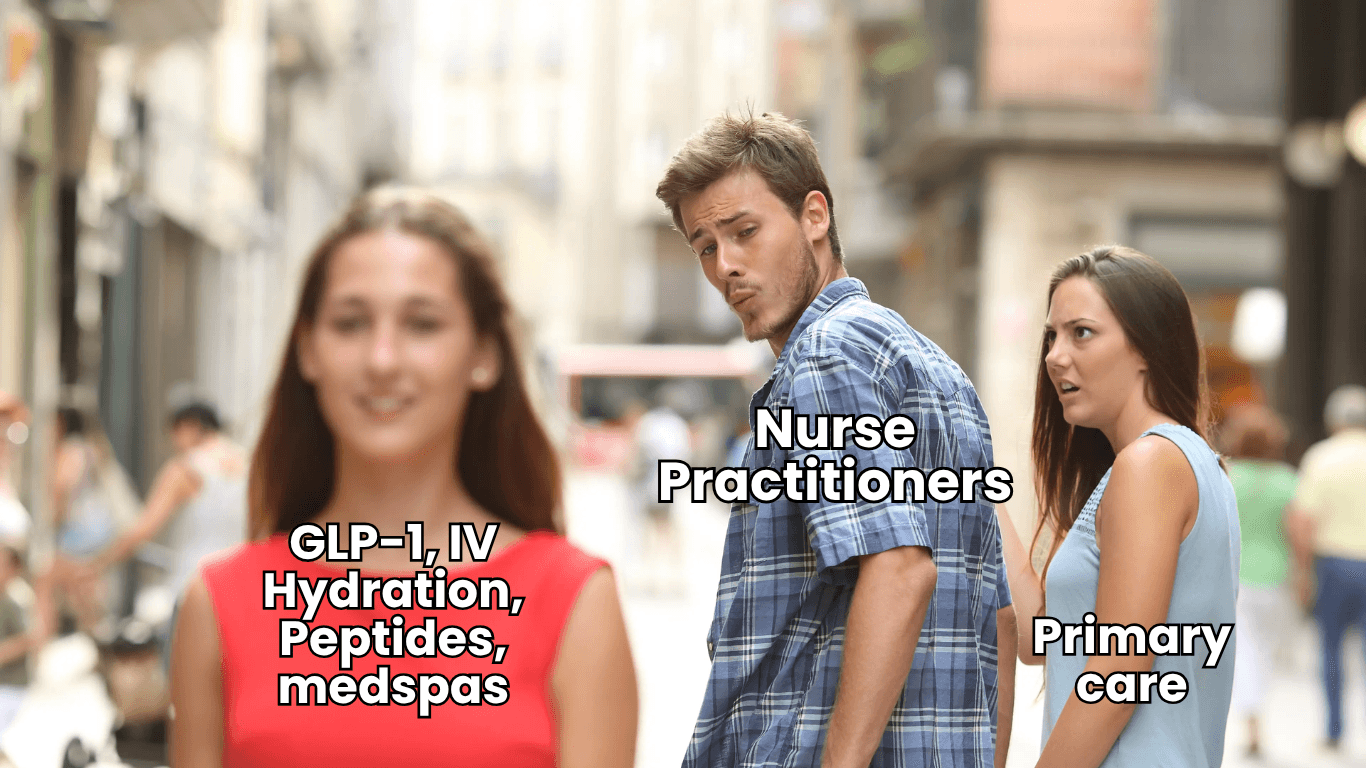
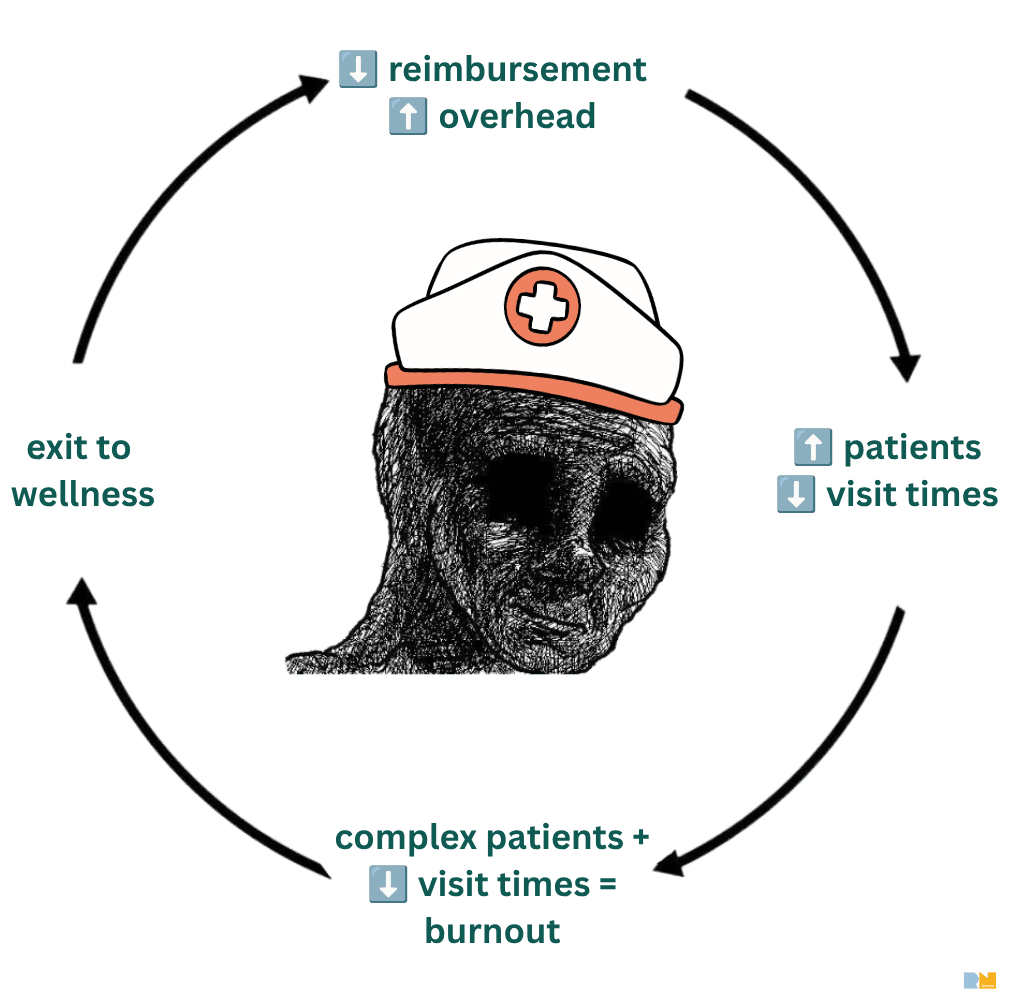
Primary care is more of a headache because the system negatively feeds on itself. I mentioned earlier that reimbursement has not increased while the cost of running the practice has increased significantly. To survive and counteract lower reimbursement rates, practices have to see more patients in less time. But the patients in real primary care are the hard ones. The newly diagnosed heart failure patient on a stack of meds, the COPD patient on home oxygen in a pharmacy desert, the person whose chart takes twenty minutes to untangle before you've said a word to them — they can't be seen in 15 minutes. Cramming more of those patients into shorter visits burns clinicians out administratively and sucks the living soul out of them emotionally, in a way an elective hormone consult never will. That's what makes the wellness route so tempting. So the harder you work to make the math work, the worse the actual job gets.
That's the doom loop. Low pay forces high volume. High volume makes the hardest work in medicine even harder to do well. So the people doing it burn out and leave, or route toward wellness, where the patients are easier, the pay is cash, and nobody's counting how many you saw. Which means fewer hands doing real primary care, which piles more onto whoever's left, which makes the next nurse practitioner even less likely to choose it. Every turn of the wheel makes primary care a little less survivable, and a little less appealing to the person deciding what kind of practice to open.
Corner coming in doesn't break the doom loop. They've built a beautiful, well-supported mario kart rainbow road exit ramp off it. The infrastructure, ownership model, and autonomy is undeniable. However, it doesn't make staying in primary care any easier. If anything, Corner has lowered the barrier for nurse practitioners to leave.
If Corner launched strict primary care clinics only, their traction would not exist. The waitlist wouldn't be anywhere near 1,000 NPs (see doom loop rant above 👆). Wellness is what makes the addressable market big enough to be venture-fundable in the first place. If they excluded it from their model, I speculate their funding raise would not have been possible. A pure primary care access play doesn't get you the numbers you need for a $25M Series A. For the pitch though? "Expanding access to primary care" sure sounds a hell of a lot more altruistic than "helping NPs launch a GLP-1 business."
No shade to the ownership model itself. I'm always a fan of empowering nurses to own a business. Nurse Entrepreneurship is, after all, my "brand." Corner puts NPs in the ownership seat instead of the workflow, so they can actually reap the upsides of being a small business owner: control of their schedule, control of their income. That's structurally different than most "NP enablement" plays, which tend to put nurses in the pipeline and say it's "innovation."
I just don't buy that this model closes the primary care gap. Big disclaimer though: this is all speculation from public-facing service tags, not actual patient case mix. I don't know what percentage of any given Corner practice's day is real primary care versus a peptide treatment. You could argue that they're expanding access because there's an option for Corner to help existing cash-pay practices and medspas start taking insurance. But we don't have that data either. Would be cool if they posted it though. 😏 Especially if they keep leading with the access story. Show us acuity data across the network, queens!! The ppl (me) are asking. Another question I'm asking just in general: Do patients even want to get their Prozac refill from the same provider selling them peptides? Where's the line?
Corner Health is not solving access to primary care definitively.
As long as NPs keep asking on subreddits, "How do I set up my own [insert wellness service here] practice?" more than they ask how to set up a primary care practice, my guess is that most of Corner's 1,000-NP waitlist will keep building wellness-adjacent practices instead of opening true primary care in rural America. Culturally, it's what we want. Economically, it's what the reimbursement math rewards. Structurally, it's what Corner's own model is built to support. Corner Health’s marketing says they're building better access to primary care. I fear they have instead built a faster exit from it.
Then we're back to square one. How do we get more Americans access to primary care?
When a friend texted me this link of Corner Health's announcement of their $25M Series A to help nurse practitioners own their own primary care practices, my initial reaction was "Where did they even find an NP who wants to run a true PCP practice? IV hydration, peptides, medspas, concierge medicine? Sure. But 'primary care' with complex longitudinal medicine? Nahh." 😬 Anecdotally, almost every clinician I know (not just NPs) considers primary care one of the more stressful fields to practice in. It's also just not sexy. Moreover, it's incredibly difficult to build a successful business with the current economic model in place.
Primary care has never been billed like the rest of medicine. Reimbursement rates for primary care visits have historically run below specialty care, which means a practice has to see a higher volume of shorter visits just to cover overhead, and that overhead has been climbing fast. One 2026 industry analysis found that Medicare physician payment rose only about 10% over the past 25 years, while practice costs, measured by the Medicare Economic Index, rose 63% over the same period.
For NPs running a practice, the financial risks and barriers are higher. One barrier being if they can even practice independently. The rules vary state by state. New York, for example, lets NPs with 3,600+ practice hours skip the formal, written collaboration agreement via its Nurse Practitioners Modernization Act, codified in NY Education Law § 6902, though a lighter form and a nominal collaborating relationship are still required. A Texas (restricted practice state) NP doesn't get that option, and still splits margins with a supervising MD for oversight New York NPs don't have to pay for. These laws also aren't static. New York's own sunset clause was just extended to 2030 this year, which is its own kind of instability.
However, I can't deny that I am a firm believer that NPs and PA's are a great solution to increasing access to primary care. So I went in giving Corner Health the benefit of the doubt.
TL;DR on Corner Health
Corner Health closed a $25 million Series A led by Oak HC/FT in July 2026, bringing its total raised to $32.5 million. Their pitch is nothing new to what NPs have been preaching all along: give nurse practitioners the infrastructure to run their own solo practices, so they don't have to choose between hospital employment and financial ruin. Their AI product, Cora, handles scheduling, billing, lab orders, referrals, and prior authorizations, the back-office labor that normally requires hiring staff most NPs can't afford to carry on their own. Also included is practice launch support, insurance credentialing, revenue cycle management, marketing/website creating, and a patient-facing care network that routes patients to Corner-affiliated providers.
Apparently it's working. Based on the numbers Corner and Oak HC/FT are sharing, the company runs 70 provider-owned practices across Arizona and Washington and says it's the fastest-growing primary care network in both states. There's a waitlist of over 1,000 NPs trying to get on the platform. 90% of Corner's clinics run with no staff beyond the practicing NP. Providers say they spend two to three times more time per patient than the industry average, and they're taking home $30,000 to $80,000 more annually than they would as employed NPs. All great PR highlights. Corner has also only launched practices in states with full-practice-authority NP laws already in place, skipping the legal headache of negotiating MD oversight contracts. Smart.
Corner's funding narrative straight up leads with solving the primary care shortage. Oak HC/FT's announcement opens by citing the stat that 100 million Americans lack a primary care provider, and frames that gap as an infrastructure problem, not a clinician shortage, arguing independent practice has been made "structurally untenable" by administrative burden. They close by calling this a bet that the future of primary care is "not less human. It is more."
But past the approachable soft blush, warm white, and aubergine color palette of Corner's website, sits a more complicated story about what "primary care" actually means here.
The tags tell the tea 🍵
The story the tags tell is a gap in primary care vs wellness-adjacent services that's wider than the gap between Spongebob's two front teeth. Only 2 of the 48 listed Primary Care as their sole tag. Another 6 listed multiple tags, like Chronic & Acute Conditions or Support Health Services, but still nothing wellness-adjacent. That's 8 out of 48, or 17%, with no wellness or aesthetic service attached at all. The other 83%? At least one tag pulling toward weight management, hormones, sports medicine, IV hydration, or similar.
And Corner isn't hiding this. Their own provider recruiting page offers to help NPs "price, market, and integrate" wellness services "alongside" insurance-covered care, and pitches total flexibility on the ratio, "80% insurance & 20% cash, or the other way around." They even market directly to existing NP medspa owners, offering to help them add primary care onto a cash-pay business they already run. To providers, Corner is upfront: build whatever mix you want, and we'll help you sell it. But that makes the access framing sus. A company that is genuinely agnostic about whether its providers practice primary care or wellness is not structurally built to solve a primary care access problem. They've built to solve an NP small-business-ownership problem. It's not the same problem.
You see, if you're going to leave it to us nurses to decide our business mix, we're gonna choose almost anything over primary care. Obviously not all nurses feel this way. But most of us are burnt out from complex patients, which makes the wellness-adjacent patient population genuinely tempting. The odds of a patient who's empowered, motivated, and health-maxxing are just higher in that population, and that makes for a more enjoyable workplace.
Primary care is more of a headache because the system negatively feeds on itself. I mentioned earlier that reimbursement has not increased while the cost of running the practice has increased significantly. To survive and counteract lower reimbursement rates, practices have to see more patients in less time. But the patients in real primary care are the hard ones. The newly diagnosed heart failure patient on a stack of meds, the COPD patient on home oxygen in a pharmacy desert, the person whose chart takes twenty minutes to untangle before you've said a word to them — they can't be seen in 15 minutes. Cramming more of those patients into shorter visits burns clinicians out administratively and sucks the living soul out of them emotionally, in a way an elective hormone consult never will. That's what makes the wellness route so tempting. So the harder you work to make the math work, the worse the actual job gets.
That's the doom loop. Low pay forces high volume. High volume makes the hardest work in medicine even harder to do well. So the people doing it burn out and leave, or route toward wellness, where the patients are easier, the pay is cash, and nobody's counting how many you saw. Which means fewer hands doing real primary care, which piles more onto whoever's left, which makes the next nurse practitioner even less likely to choose it. Every turn of the wheel makes primary care a little less survivable, and a little less appealing to the person deciding what kind of practice to open.
Corner coming in doesn't break the doom loop. They've built a beautiful, well-supported mario kart rainbow road exit ramp off it. The infrastructure, ownership model, and autonomy is undeniable. However, it doesn't make staying in primary care any easier. If anything, Corner has lowered the barrier for nurse practitioners to leave.
If Corner launched strict primary care clinics only, their traction would not exist. The waitlist wouldn't be anywhere near 1,000 NPs (see doom loop rant above 👆). Wellness is what makes the addressable market big enough to be venture-fundable in the first place. If they excluded it from their model, I speculate their funding raise would not have been possible. A pure primary care access play doesn't get you the numbers you need for a $25M Series A. For the pitch though? "Expanding access to primary care" sure sounds a hell of a lot more altruistic than "helping NPs launch a GLP-1 business."
No shade to the ownership model itself. I'm always a fan of empowering nurses to own a business. Nurse Entrepreneurship is, after all, my "brand." Corner puts NPs in the ownership seat instead of the workflow, so they can actually reap the upsides of being a small business owner: control of their schedule, control of their income. That's structurally different than most "NP enablement" plays, which tend to put nurses in the pipeline and say it's "innovation."
I just don't buy that this model closes the primary care gap. Big disclaimer though: this is all speculation from public-facing service tags, not actual patient case mix. I don't know what percentage of any given Corner practice's day is real primary care versus a peptide treatment. You could argue that they're expanding access because there's an option for Corner to help existing cash-pay practices and medspas start taking insurance. But we don't have that data either. Would be cool if they posted it though. 😏 Especially if they keep leading with the access story. Show us acuity data across the network, queens!! The ppl (me) are asking. Another question I'm asking just in general: Do patients even want to get their Prozac refill from the same provider selling them peptides? Where's the line?
Corner Health is not solving access to primary care definitively.
As long as NPs keep asking on subreddits, "How do I set up my own [insert wellness service here] practice?" more than they ask how to set up a primary care practice, my guess is that most of Corner's 1,000-NP waitlist will keep building wellness-adjacent practices instead of opening true primary care in rural America. Culturally, it's what we want. Economically, it's what the reimbursement math rewards. Structurally, it's what Corner's own model is built to support. Corner Health’s marketing says they're building better access to primary care. I fear they have instead built a faster exit from it.
Then we're back to square one. How do we get more Americans access to primary care?
⏱️ Before You Clock Out
Check out my article on nurse.org. I'm kind of legit now I guess.
Home health is an operational behemonth. Listen to how Axle Health's created an OS for it.
NurseHack4Health applications are almost closed for 2026. Don't leave 400k of grant money on the table!
⏱️ Before You Clock Out
Check out my article on nurse.org. I'm kind of legit now I guess.
Home health is an operational behemonth. Listen to how Axle Health's created an OS for it.
NurseHack4Health applications are almost closed for 2026. Don't leave 400k of grant money on the table!