
BSN, RN, CCRN
One handed wound care woes: A wound care software market map 🗺️ (Part 1)
One handed wound care woes: A wound care software market map 🗺️ (Part 1)
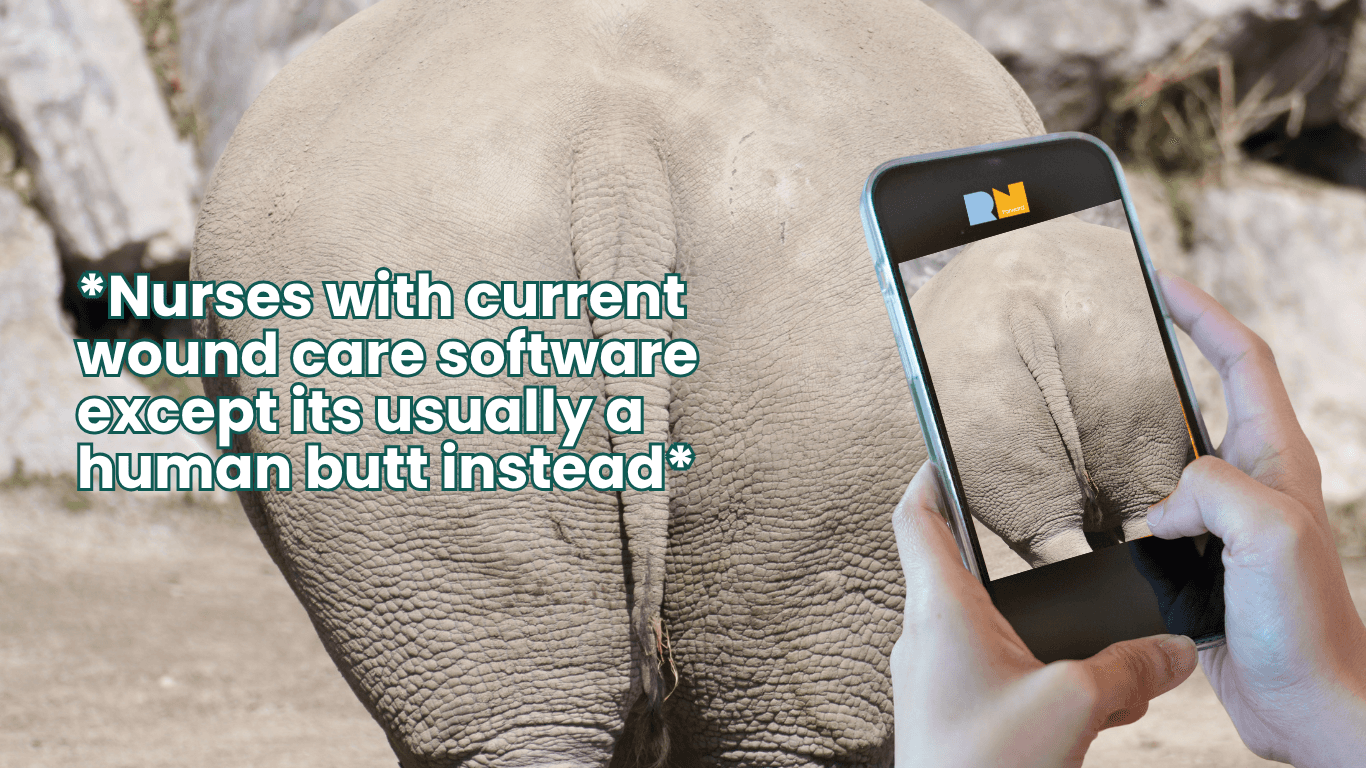
A wound assessment looks kinda like this for most bedside nurses right now: Take a picture on your phone → measure the wound manually with a paper ruler → guess the stage → and then guess some more as to what treatment it probably needs until the wound care nurse can finally come and tell you what you should have done. That's the workflow in most bedside settings.
We've been tracking the wound care software space for a while now, mostly because companies like Altvis Medical and Wound Care Pro are nurse-founded, and nurse leaders like Rob Fraser at Swift Medical and Julie Roskamp at The Wound Company are prominent voices in the category. 1 nurse founded wound care company was also acquired. The point is, nurses have been building here for a long time.
So we mapped all of it out. 12 companies, three clusters, a bunch of observations about funding, and one product assumption the whole category seems to share: nurses can do wound care with one hand.
The Wound Care Software Landscape
Back in 2002, two nurses named Paul Montenegro and Wendy Smollock founded a company called Wound Healing Solutions, which deployed wound-certified nurse practitioners directly into long-term care facilities to run bedside wound programs. It got acquired in 2014. The model was simple: nursing facilities don't have wound specialists on staff, so we'll send ours in. That was the response to the problem more than a decade ago. Fast forward to now and the the problem remains the same: we still don't have enough wound care nurses. Except this time, technology has improved greatly.
For the current landscape I kept the scope tight, just software and virtual services. No physical devices, no dressings, no prevention hardware. Just the category that claims to be modernizing the assessment-to-documentation-to-treatment workflow.
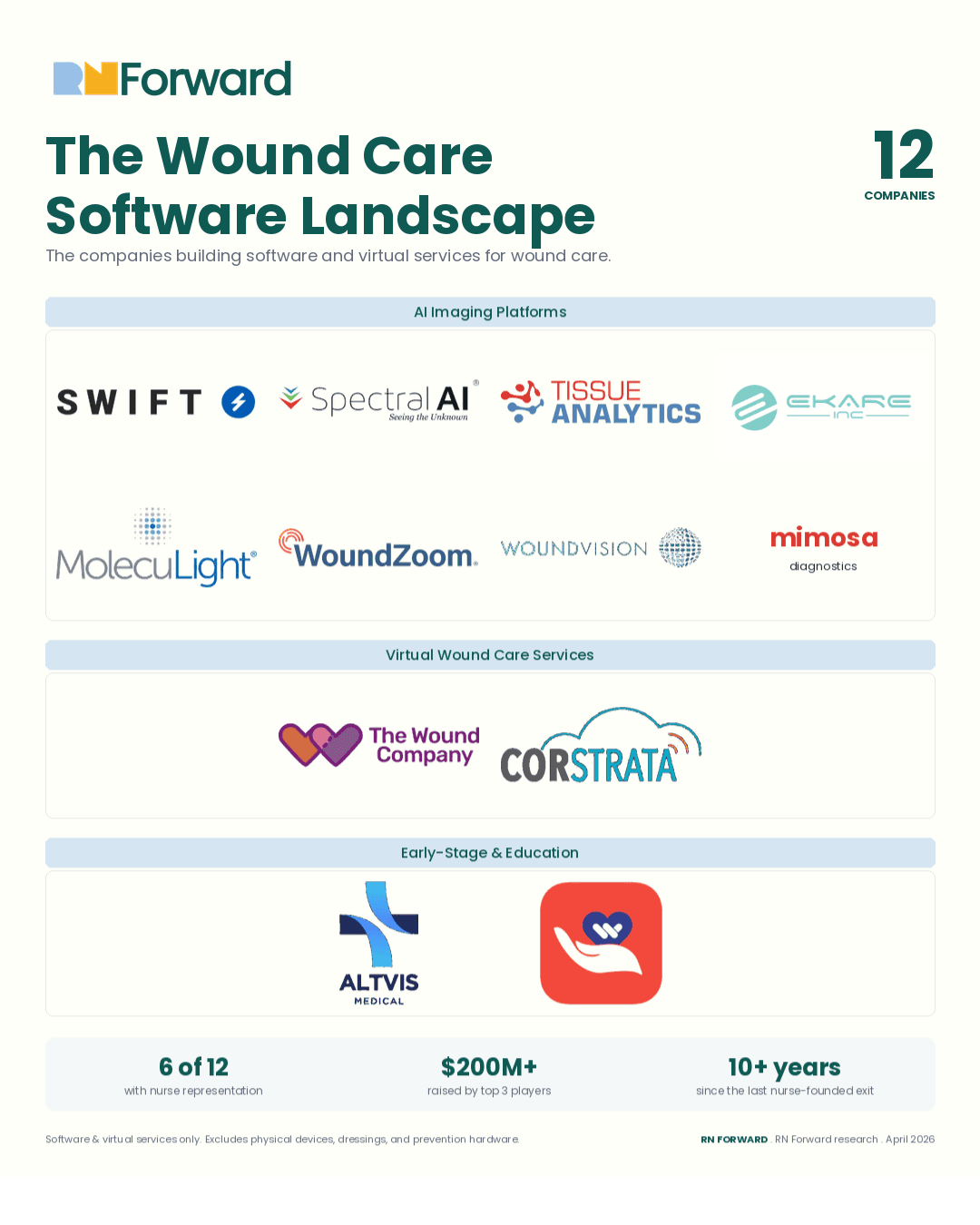
There are three clusters. The AI imaging platforms are the crowded, well-capitalized category, and they include Swift Medical, Spectral AI, Tissue Analytics (acquired by Net Health in 2020), eKare, MolecuLight, Perceptive Solutions (WoundZoom), WoundVision, and Mimosa Diagnostics. The virtual wound care services, which connect specialist nurse networks to home health, hospice, and SNF workflows, include The Wound Company and Corstrata. And then there's early-stage software with an AI imaging plus consumables play from Altvis Medical.
The capital in this space is incredibly lopsided. Swift Medical has raised over $54M. Spectral AI has a BARDA contract valued up to $150M, with $54.9M committed to date, and is publicly traded, Tissue Analytics exited to Net Health. eKare and MolecuLight are venture-backed with undisclosed totals. On the other end, The Wound Company raised a $4.25M seed round, Corstrata has been bootstrapped for a decade, and Altvis is pre-seed. There's also Wound Care Pro, a bootstrapped educational wound care app built by Anne Walsh, ANP-BC, CWOCN, ACHPN. It's direct-to-clinician, one-time purchase, and it's basically one CWOCN trying to close the wound care knowledge gap one download at a time. It isn't really on the same map as the others, but it exists in the same space and it's worth naming.
TLDR of each company
Company | Nurse Representation | Product |
|---|---|---|
Swift Medical | Nurse Executive. Rob Fraser (BScN, MN, RN, NSWOC, WOCC(C)) is GM & VP of Advanced Clinical Solutions. Amy Cassata (BSN, RN, WCC) is CNO. Founded 2015 by three biomedical engineers (Carlo Perez, Edwin Liang, Justin Allport). CEO Brian Litten is not a clinician. | AI-powered smartphone wound imaging and documentation platform. $54.6M+ raised. |
Spectral AI | Mary Regan, PhD (RN background, SUNY Upstate Medical) runs Clinical Affairs at VP level. Founded 2009 by Dr. J. Michael DiMaio, a cardiothoracic surgeon. | DeepView handheld multispectral imaging with AI healing prediction. BARDA contract valued up to $150M, $54.9M committed to date. |
Tissue Analytics | None. Founded 2014 by biomedical engineers Kevin Keenahan, Josh Budman, and Gabriel Brat out of Johns Hopkins CBID. | Smartphone AI wound imaging and analytics. Acquired by Net Health in 2020. |
eKare | None. Founded 2014 by Patrick Cheng, Kyle Wu (MD/MBA), and Özgür Güler, spun out of Children's National Medical Center. | inSight 3D wound imaging platform using computer vision. |
MolecuLight | None. Founded 2012 by Dr. Ralph DaCosta, a cancer imaging researcher. CEO Anil Amlani is a career medical-device executive. | Handheld fluorescence imaging device that detects bacterial burden in wounds. |
Perceptive Solutions (WoundZoom) | None identified. Founded 2012. President Mark Lacerte. | Mobile point-of-care wound assessment app with AI measurement. |
WoundVision | None identified. | Handheld thermal imaging (Scout device) for wound documentation. |
Mimosa Diagnostics | None identified. | MIMOSA Pro handheld near-infrared imaging for tissue oxygenation assessment. |
The Wound Company | Nurse Led. Julie Roskamp (CWOCN, 30+ years) heads Care Delivery. Founded 2021 by Nima Ahmadi, ex-Abbott/Cardiovascular Systems. Not a nurse himself. | Virtual wound care platform for home health and hospice. $4.25M seed. |
Corstrata | Nurse Led. VP Clinical Operations Alicia Jenkins (RN, BS, CWCN). Jan Cuzzell runs Corstrata Nursing Services. Entire delivery model is board-certified wound nurses. Founded 2015 by Katherine Piette and Joseph Ebberwein, neither nurses. | Virtual wound and ostomy telehealth service. Bootstrapped, 10+ years operating. |
Altvis Medical | Nurse Founded. Kathleen Reyes, RN. | WoundScan AI imaging plus WoundPaks single-serving wound supply kits. Pre-seed. |
Wound Care Pro | Nurse Founded. Anne Walsh, ANP-BC, CWOCN, ACHPN. | Educational wound care app for clinicians. Bootstrapped, one-time purchase. |
Two nurse-founded companies in the active software landscape. Two nurse-led clinical layers under non-nurse founders. One nurse executive at the largest player. Clinical research leadership with nursing credentials at a second. Everyone else is engineers, surgeons, and medical-device veterans.
📱 The form-factor problem
I had a lightbulb moment when I laid all of it out side by side. 💡
Every single one of these companies, regardless of size, stage, or funding, built roughly the same product. A clinician holds a device, the clinician points the device at the wound, the clinician captures an image, the clinician documents, and the clinician moves on.
Swift Medical uses a phone. eKare uses a phone. Tissue Analytics uses a phone. WoundZoom uses a phone. Altvis Medical uses a phone. Spectral AI uses a handheld multispectral device. WoundVision uses a handheld thermal camera. Mimosa uses a handheld near-infrared imager. MolecuLight uses a handheld fluorescence imager. The virtual services use phones on the clinician's end to transmit images to a remote wound nurse.
The form factor is the same everywhere you look, which means the assumptions behind the form factor are the same, and those assumptions don't match the reality of bedside nursing.
Bedside nurses don't have a free hand. We're in gloves, we're repositioning a patient, we're managing lines, and we're on a clock. Asking us to pick up a device and operate it one-handed while our other hand is digging through wound secretions while processing clinical information is a workflow tax that the product design has quietly offloaded onto the clinician.
And that's before we get to the more basic problem: most bedside nurses aren't using these products at all. Hospitals are still struggling to adopt basic wound care apps. The charting is still subjective. The paper ruler is still out. You can't solve continuity of wound monitoring if clinicians aren't capturing the wound in the first place. And right now, most of them aren't. 🥲
What comes next?
I've had all of this information noodling around in my head for a while now, and I finally word-vomited it into Claude to actually make sense of it, which is how this post exists. You're welcome (especially since this content is free. 😜)
The thing that always bothered me about the existing solutions was that none of them seemed to account for how genuinely gross wound care is. I need both of my hands to get into the nooks and crannies of people's skin, pack a tunnel, or handle dressing changes on a sacrum that isn't cooperating. I cannot hold a phone while I do that, and I don't think the product teams who designed these apps realize how difficult it is.
In the part two of the Wound Care Software Market Map series, I'll talk about the Out-Of-Pocket Hardware Edition hackathon I participated in this past weekend, where our team built something for this space from a very different starting point. You can check that out next.
A wound assessment looks kinda like this for most bedside nurses right now: Take a picture on your phone → measure the wound manually with a paper ruler → guess the stage → and then guess some more as to what treatment it probably needs until the wound care nurse can finally come and tell you what you should have done. That's the workflow in most bedside settings.
We've been tracking the wound care software space for a while now, mostly because companies like Altvis Medical and Wound Care Pro are nurse-founded, and nurse leaders like Rob Fraser at Swift Medical and Julie Roskamp at The Wound Company are prominent voices in the category. 1 nurse founded wound care company was also acquired. The point is, nurses have been building here for a long time.
So we mapped all of it out. 12 companies, three clusters, a bunch of observations about funding, and one product assumption the whole category seems to share: nurses can do wound care with one hand.
The Wound Care Software Landscape
Back in 2002, two nurses named Paul Montenegro and Wendy Smollock founded a company called Wound Healing Solutions, which deployed wound-certified nurse practitioners directly into long-term care facilities to run bedside wound programs. It got acquired in 2014. The model was simple: nursing facilities don't have wound specialists on staff, so we'll send ours in. That was the response to the problem more than a decade ago. Fast forward to now and the the problem remains the same: we still don't have enough wound care nurses. Except this time, technology has improved greatly.
For the current landscape I kept the scope tight, just software and virtual services. No physical devices, no dressings, no prevention hardware. Just the category that claims to be modernizing the assessment-to-documentation-to-treatment workflow.
There are three clusters. The AI imaging platforms are the crowded, well-capitalized category, and they include Swift Medical, Spectral AI, Tissue Analytics (acquired by Net Health in 2020), eKare, MolecuLight, Perceptive Solutions (WoundZoom), WoundVision, and Mimosa Diagnostics. The virtual wound care services, which connect specialist nurse networks to home health, hospice, and SNF workflows, include The Wound Company and Corstrata. And then there's early-stage software with an AI imaging plus consumables play from Altvis Medical.
The capital in this space is incredibly lopsided. Swift Medical has raised over $54M. Spectral AI has a BARDA contract valued up to $150M, with $54.9M committed to date, and is publicly traded, Tissue Analytics exited to Net Health. eKare and MolecuLight are venture-backed with undisclosed totals. On the other end, The Wound Company raised a $4.25M seed round, Corstrata has been bootstrapped for a decade, and Altvis is pre-seed. There's also Wound Care Pro, a bootstrapped educational wound care app built by Anne Walsh, ANP-BC, CWOCN, ACHPN. It's direct-to-clinician, one-time purchase, and it's basically one CWOCN trying to close the wound care knowledge gap one download at a time. It isn't really on the same map as the others, but it exists in the same space and it's worth naming.
TLDR of each company
Company | Nurse Representation | Product |
|---|---|---|
Swift Medical | Nurse Executive. Rob Fraser (BScN, MN, RN, NSWOC, WOCC(C)) is GM & VP of Advanced Clinical Solutions. Amy Cassata (BSN, RN, WCC) is CNO. Founded 2015 by three biomedical engineers (Carlo Perez, Edwin Liang, Justin Allport). CEO Brian Litten is not a clinician. | AI-powered smartphone wound imaging and documentation platform. $54.6M+ raised. |
Spectral AI | Mary Regan, PhD (RN background, SUNY Upstate Medical) runs Clinical Affairs at VP level. Founded 2009 by Dr. J. Michael DiMaio, a cardiothoracic surgeon. | DeepView handheld multispectral imaging with AI healing prediction. BARDA contract valued up to $150M, $54.9M committed to date. |
Tissue Analytics | None. Founded 2014 by biomedical engineers Kevin Keenahan, Josh Budman, and Gabriel Brat out of Johns Hopkins CBID. | Smartphone AI wound imaging and analytics. Acquired by Net Health in 2020. |
eKare | None. Founded 2014 by Patrick Cheng, Kyle Wu (MD/MBA), and Özgür Güler, spun out of Children's National Medical Center. | inSight 3D wound imaging platform using computer vision. |
MolecuLight | None. Founded 2012 by Dr. Ralph DaCosta, a cancer imaging researcher. CEO Anil Amlani is a career medical-device executive. | Handheld fluorescence imaging device that detects bacterial burden in wounds. |
Perceptive Solutions (WoundZoom) | None identified. Founded 2012. President Mark Lacerte. | Mobile point-of-care wound assessment app with AI measurement. |
WoundVision | None identified. | Handheld thermal imaging (Scout device) for wound documentation. |
Mimosa Diagnostics | None identified. | MIMOSA Pro handheld near-infrared imaging for tissue oxygenation assessment. |
The Wound Company | Nurse Led. Julie Roskamp (CWOCN, 30+ years) heads Care Delivery. Founded 2021 by Nima Ahmadi, ex-Abbott/Cardiovascular Systems. Not a nurse himself. | Virtual wound care platform for home health and hospice. $4.25M seed. |
Corstrata | Nurse Led. VP Clinical Operations Alicia Jenkins (RN, BS, CWCN). Jan Cuzzell runs Corstrata Nursing Services. Entire delivery model is board-certified wound nurses. Founded 2015 by Katherine Piette and Joseph Ebberwein, neither nurses. | Virtual wound and ostomy telehealth service. Bootstrapped, 10+ years operating. |
Altvis Medical | Nurse Founded. Kathleen Reyes, RN. | WoundScan AI imaging plus WoundPaks single-serving wound supply kits. Pre-seed. |
Wound Care Pro | Nurse Founded. Anne Walsh, ANP-BC, CWOCN, ACHPN. | Educational wound care app for clinicians. Bootstrapped, one-time purchase. |
Two nurse-founded companies in the active software landscape. Two nurse-led clinical layers under non-nurse founders. One nurse executive at the largest player. Clinical research leadership with nursing credentials at a second. Everyone else is engineers, surgeons, and medical-device veterans.
📱 The form-factor problem
I had a lightbulb moment when I laid all of it out side by side. 💡
Every single one of these companies, regardless of size, stage, or funding, built roughly the same product. A clinician holds a device, the clinician points the device at the wound, the clinician captures an image, the clinician documents, and the clinician moves on.
Swift Medical uses a phone. eKare uses a phone. Tissue Analytics uses a phone. WoundZoom uses a phone. Altvis Medical uses a phone. Spectral AI uses a handheld multispectral device. WoundVision uses a handheld thermal camera. Mimosa uses a handheld near-infrared imager. MolecuLight uses a handheld fluorescence imager. The virtual services use phones on the clinician's end to transmit images to a remote wound nurse.
The form factor is the same everywhere you look, which means the assumptions behind the form factor are the same, and those assumptions don't match the reality of bedside nursing.
Bedside nurses don't have a free hand. We're in gloves, we're repositioning a patient, we're managing lines, and we're on a clock. Asking us to pick up a device and operate it one-handed while our other hand is digging through wound secretions while processing clinical information is a workflow tax that the product design has quietly offloaded onto the clinician.
And that's before we get to the more basic problem: most bedside nurses aren't using these products at all. Hospitals are still struggling to adopt basic wound care apps. The charting is still subjective. The paper ruler is still out. You can't solve continuity of wound monitoring if clinicians aren't capturing the wound in the first place. And right now, most of them aren't. 🥲
What comes next?
I've had all of this information noodling around in my head for a while now, and I finally word-vomited it into Claude to actually make sense of it, which is how this post exists. You're welcome (especially since this content is free. 😜)
The thing that always bothered me about the existing solutions was that none of them seemed to account for how genuinely gross wound care is. I need both of my hands to get into the nooks and crannies of people's skin, pack a tunnel, or handle dressing changes on a sacrum that isn't cooperating. I cannot hold a phone while I do that, and I don't think the product teams who designed these apps realize how difficult it is.
In the part two of the Wound Care Software Market Map series, I'll talk about the Out-Of-Pocket Hardware Edition hackathon I participated in this past weekend, where our team built something for this space from a very different starting point. You can check that out next.
⏱️ Before You Clock Out
👉 Did I miss a company that belongs on this map? Send them my way. I wanna know about it.
👉 Register to attend the official Claude Code for Healthcare: How Physicians Build with AI webinar on April 23, 2026.
⏱️ Before You Clock Out
👉 Did I miss a company that belongs on this map? Send them my way. I wanna know about it.
👉 Register to attend the official Claude Code for Healthcare: How Physicians Build with AI webinar on April 23, 2026.